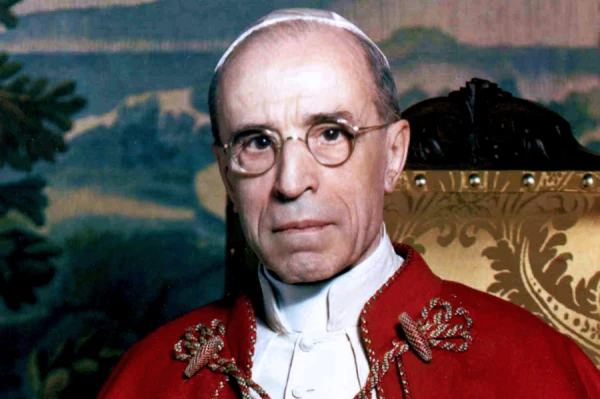
Denver Newsroom, Sep 9, 2020 / 04:00 am (CNA).- Scholars of Pope Pius XII have countered claims that the wartime pope and the Catholic Church hierarchy were complicit in a controversial post-war custody battle over two Jewish orphans who were baptized Christians in France, then hidden from their relatives.
Researcher William Doino Jr. told CNA a recent article on the topic in The Atlantic is “both flawed and misleading, because it misrepresents and cites out of context a small portion of the newly released archives to advance a one-sided view of Pius XII– and omits key documents and evidence which contradict the article’s main allegations.”
He responded to historian David I. Kertzer, writing in The Atlantic, who has claimed that the archives have now revealed “the central role that the Vatican and the pope himself played in the kidnapping drama.”
“The Vatican helped direct efforts by local Church authorities to resist French court rulings and to keep the boys hidden, while at the same time carefully concealing the role that Rome was playing behind the scenes,” Kertzer wrote Aug. 27.
Those claims have also drawn criticism from Matteo Luigi Napolitano, professor of history of international relations at Italy’s University of Molise said in L’Osservatore Romano Sept. 3.
“Things are obviously much more complex if we look at the Jewish sources,” he said. “The Rabbinate wanted to maintain dialogue with the Vatican, while other organizations would have gone to the clash, to be exploited on the media level.”
The archives on Pope Pius XII’s pontificate were opened in 2020 for only four days before being closed again due to coronavirus restrictions. Napolitano said scholars have only had about forty days’ worth of work on the new material.
Napolitano is thus critical of the claims of Kertzer regarding the wartime papacy of Pius XII and the Finaly brothers controversy.
In February 1944, agents of the Gestapo arrested a refugee Jewish Austrian couple, Fritz and Annie Finaly, in a French village. They were transported to Auschwitz and killed. Their children, three-year-old Robert and two-year-old Gerald, were taken in by a Catholic woman, Antoinette Brun, who ran a foundling home in Grenoble.
Brun began the legal process to adopt them in 1945, when she learned their parents had been killed. At the same time, the boys’ relatives sought to take custody of them. An aunt from New Zealand asked the boys be sent to her, but Brun resisted. In 1948, she baptized the boys, making them Catholic in the eyes of the Church.
A custody struggle ensued, with both religious and national elements, citing the father’s reported desire to have his sons brought up in France, the boys’ reported desire to stay with Brun, calls to have the boys brought up Christian, and calls to return the boys to their family.
When courts said the boys should be placed with their relatives, the boys were taken by friends of Brun and hidden near France’s border with Spain.
Brun, a Catholic nun who helped her, and several Catholic clergymen were arrested.
“Several arrests were made, and the Church got some bad press. Contrary to what the critics claimed, however, the Catholics involved were not acting on behalf of the institutional Church,” said Ronald Rychlak, a law professor at the University of Mississippi School of Law and an expert on the history of Pius XII and the Nazis in the Second World War, wrote in an essay he sent to CNA in late August.
“When she was asked by the press about her Catholicism, Brun said she ‘didn’t give a fig for the pope.’ Bishop Alexandre Calliot of Grenoble took to the radio airwaves to demand that anyone with information about the missing boys contact the authorities. One of the first to comply was a priest in Spain who reported on their whereabouts.”
Doino characterized Brun as “a renegade Catholic.”
“She and a small group of collaborators evaded Church officials at every turn, after they demanded she return the children to their Jewish relatives,” he told CNA.
Doino pointed to an article he co-authored with Rychlak for Inside the Vatican Magazine’s a January-February 2005 issue, which used primary source documents and first-hand testimonies to disprove a claim he helped refuse to return baptized Jewish children to their surviving family members after the Second World War.
He told a Polish Catholic woman to return a baptized child to its father, saying it “was her duty as a Catholic not only to give back the child, but do it with good will and in friendship,” said Doino, who recommended Peter Hellman’s 1980 book Avenue of the Righteous.
Rychlak said Pius XII approved an agreement negotiated between Cardinal Pierre-Marie Gerlier of Lyons and the chief rabbi of Paris: the children would go to their relatives in France, but would be allowed free choice of religion. The pope approved this despite some leading advisors who wanted to reject any agreement in which Catholic children would live in a Jewish home.
In Kertzer’s telling, a Vatican document from Catholic sources in Grenoble appeared to describe positively Brun’s refusal to return the children.
Napolitano, however, said that Jewish sources show that the Bishop of Grenoble and the Archbishop of Lyons both worked with the judicial authority to track down the brothers after they were concealed in Spain.
Jewish sources reported that “the French clergy have already intervened with the Spanish clergy and that they are on the point of taking the children home.”
Napolitano said Vittorio Segre, press officer at the Israeli Embassy in Paris during the controversy, shows a “much more complex picture.”
In Segre’s account, the embassy officer said it is “logical to assume that there was support from the Vatican” for the agreement of Cardinal Gerlier through the former secretary of Charles de Gaulle, who was charged with tracking down the Finaly brothers.
According to Segre, there was “never a conflict between the Catholic Church and the Jewish community.” De Gaulle’s former secretary “worked in complete freedom, without encountering obstacles in the hierarchies.”
“There were difficulties, but they came from a much lower level,” said Segre.
While Kertzer’s essay claimed that relevant documents were now reported for the first time, Rychlak compared his work to a 2004 controversy in which the New York Times reported on a document from a French archive purporting to show Vatican authorization for church authorities not to return “hidden” Jewish children to their families if they had been baptized.
“To those of us who had studied the work of Pius XII, the directive immediately seemed suspicious, and for good reason,” Rychlak wrote. “The real directive, dated October 23, 1946, and authorized by Pope Pius XII, was quickly found in the Vatican archives. It was quite different from what had been reported in the news.”
“The directive told the rescuers to return these children, baptized or not, to blood-related relatives who came to get them,” Rychlak said. “Over and above that, if no relatives survived to reclaim the children, and if individuals or organizations unrelated to the children now wished to adopt them or transfer them to a new environment, each request was to be examined on a case-by-case basis, always with a sense of justice for the child, and with a sense of what their parents would have wanted for them.”
“This directive is perfectly in line with Judeo-Christian compassion and responsibility. It is also very probative of Pius XII’s mindset on these issues,” he said, saying this is far better evidence than internal memoranda.
Kertzer said other newly revealed documents justify repeated claims that Pius XII had been persuaded “not to speak out in protest after the Germans rounded up and deported Rome’s Jews in 1943.” He claimed memoranda was “steeped in anti-Semitic language.”
“The silence of Pius XII during the Holocaust has long engendered bitter debates about the Roman Catholic Church and Jews,” he said, repeating a claim long disputed by the Pope’s defenders.
For Kertzer, one piece of evidence is a December 1943 memo from Monsignor Angelo Dell’Acqua, an official in the Vatican’s Secretariat of State, about whether it was right to openly and officially protest mistreatment of Jews by Germans. Kertzer interpreted the memo as a sign of anti-Semitism and Church silence.
However, Napolitano said the note came just two months after the Oct. 16, 1943 Nazi raid on Rome’s Jewish ghetto, which resulted in over 1,000 Jews being deported to Auschwitz.
Vatican officials objected to that raid, but were also aware of the danger of reprisals from the Nazis. Napolitano cited the diary of Slovakian ambassador Karl Sidor, which said: “On the orders of the Holy Father, more than one hundred Jews and Italian officers are hidden in the Jesuit Generalate. Likewise, Jews with their entire families are hidden in every convent. The Holy Father provides for their nourishment. Money and food arrive from the Vatican. This is very important news. This is the way the Vatican is dealing with the Jews.”
Documents from the Pius XII papacy, Napolitano said, come in the context of Church efforts “not to compromise the network of aid that had been activated throughout Rome to ensure that Jews and wanted people of all kinds escaped arrest and deportation.”
“It does not seem that Kertzer takes this into account,” Napolitano wrote in L’Osservatore Romano.
He also faulted Kertzer’s depiction of Dell’Acqua as an anti-Semite, given that the priest was a close collaborator with Pope John XXIII, who would not have named him a bishop and apostolic nuncio to France “if he had the slightest suspicion of his anti-Semitic inclinations.” Similarly, Paul VI, another pioneer in Catholic-Jewish relations, would not have elevated Dell’Acqua to the cardinalate.
“These are logical discrepancies that Kertzer does not resolve,” said Napolitano. “But history, like nature, does not allow for leaps.”

[…]




Leave a Reply